Where the next pump is 300 km away
In the emptiest corners of the world's great road trips, fuel is the thing that shapes your day. Here is how to plan it so the gauge never decides for you.
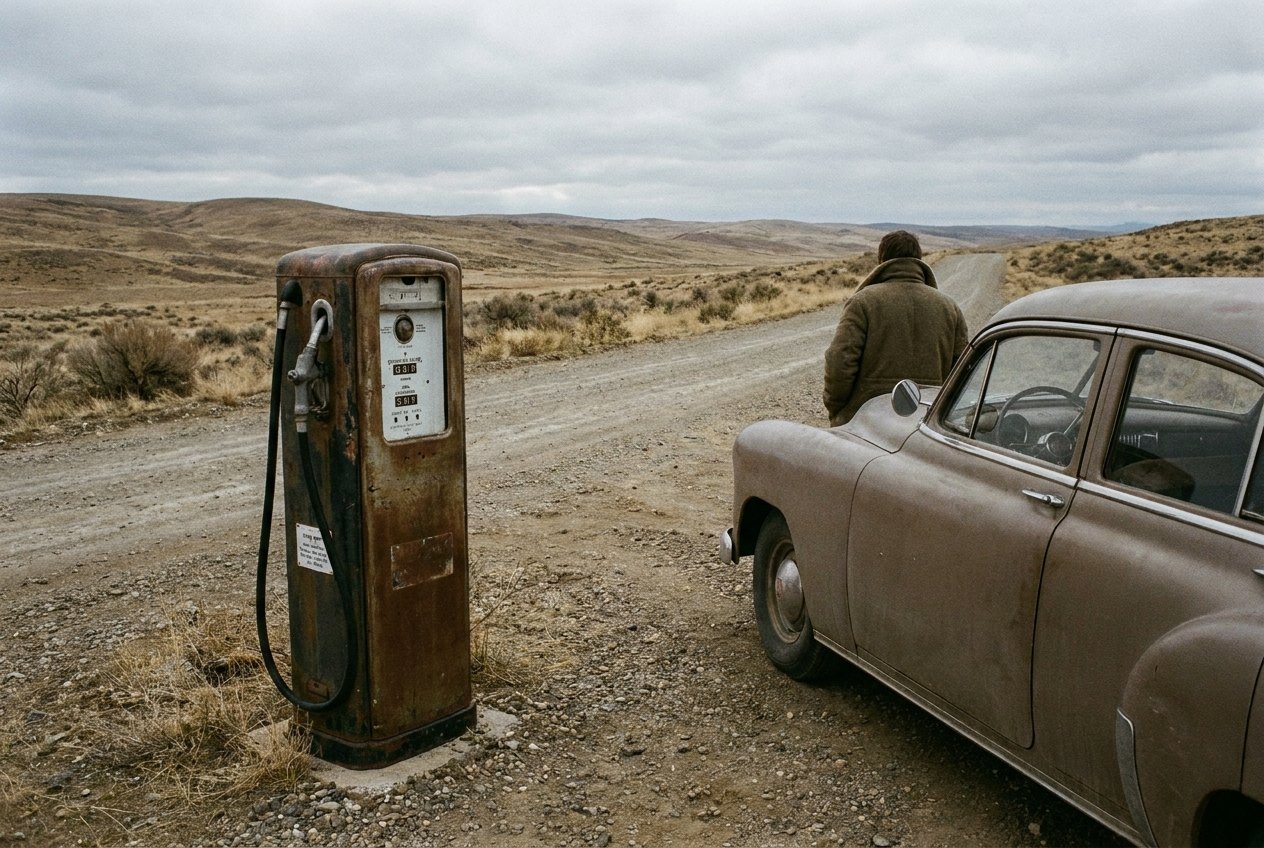
On most road trips you can ignore the fuel gauge until the light comes on. On some of the drives on this site, that is a mistake you only make once. In Patagonia, on the long empty stretches of Iceland's east, in the Australian outback and in the far south of Chile, fuel stations can be hours apart, and the one you were counting on may be closed, out of fuel or not take your card.
The good news is that a little planning removes almost all of the risk.
The half-tank rule
The simplest rule is the one most experienced drivers follow: in remote country, fill up whenever the tank is half empty or less and you pass a working pump. Do not drive past a station thinking you will stop at the next one.
The half-tank rule gives you a margin for the things that go wrong: a closed station, a detour around a closed road, a headwind that pushes your fuel use up, or a side trip you had not planned. Strong wind, gravel, steep climbs, a heavily loaded car and air conditioning all use more fuel than you expect.
Know your car's range. Fill the tank completely, note the distance, and work out roughly how far it goes on a full tank in real conditions rather than trusting the figure on the dashboard.
Where the gaps are longest
A few places on this site deserve special care.
- Ruta 40 in Patagonia. The stretch north of El Calafate has long gaps between towns, and a small station can run out of fuel in high season. Fill up in every town.
- The Carretera Austral. Fuel is available in the main towns, but the gaps can be long and ferries can delay you.
- Iceland's east and north. The Ring Road has fuel at regular intervals, but stations are further apart in the east, and side roads into the highlands have none.
- The Australian outback. Roadhouses can be several hundred kilometres apart, and some keep limited hours.
- The Milford Road in New Zealand. There is no fuel after Te Anau, so fill up there before the drive in and out.
Long distances usually mean gravel and remote country too, so read our notes on gravel in a hire car before you set out on any of these roads.
Detour · stop 12Gravel roads in a hire car: what to check before you leaveThe right fuel in the tank
It sounds obvious, but check whether your hire car takes petrol or diesel before you reach the first pump, and look for a label inside the fuel flap. Pump names differ from country to country and are not always in English. In Argentina, for example, petrol is usually called nafta and diesel is gasoil, and colours on the nozzles do not follow one standard around the world.
Putting the wrong fuel in a modern car can do expensive damage, and hire contracts rarely cover it. If you realise at the pump, do not start the engine: call the hire company and wait for help. In remote places, some small stations sell only one kind of fuel, so a diesel car in a petrol-only village is a real problem. Check which fuels the stations on your route sell before you rely on them.
Cards, cash and unattended pumps
Paying for fuel is not always simple. In some countries, including Iceland, many pumps are unattended and take only cards with a PIN. A card that works by signature or tap alone may be refused. Check that you know your card's PIN before you leave home, and carry more than one card.
In other places, cash is king. Small stations in rural Argentina and Chile may take only cash, and cash machines in small towns can run dry in high season. Carry enough local currency to fill the tank at least twice.
In the outback, roadhouses usually accept cards, but power and network failures happen. A cash reserve is the backup.
Carrying extra fuel
A spare fuel can sounds like the obvious answer, and in some places it is. But there are rules. Many hire contracts restrict carrying fuel in the car, ferries and border crossings may have their own requirements, and only approved containers should ever be used. Fuel vapour in a closed car is dangerous.
If you do carry fuel, use a container designed for the purpose, keep it outside the passenger compartment where possible, secure it so it cannot move, and never fill it to the brim. Check the rules for the country and the hire company before you buy one. In most places, planning your fuel stops properly means you will not need it.
Signal, maps and telling someone
The places where fuel stations are far apart are usually also the places where your phone loses signal. Download offline maps before you leave, and note the towns and fuel stops along your route on paper as well.
Tell someone where you are going and when you expect to arrive, especially if you are driving alone. If you break down or run out of fuel, stay with the car: it is easier to spot than a person walking, and it gives you shelter.
Carry water, food, warm clothes and a torch in the car. In hot country, carry much more water than you think you need.
A simple fuel plan
- Before you leave, list the fuel stops along your route and the distance between them.
- Check your car's real range and add a margin of at least a quarter.
- Fill up whenever the tank is half empty and you pass a working pump.
- Carry cash and at least two cards, one with a PIN.
- Download maps and tell someone your plans.
For more on the timing of these trips, see the shoulder months on every road: some stations keep shorter hours or close altogether out of season.
The photographs on this stop are credited, with their licences, on who took the road photos.