A road built as a memorial
The Great Ocean Road runs about 240 km along the south-west coast of Victoria, from Torquay to Allansford near Warrnambool, signed as the B100. It was built between 1919 and the early 1930s by soldiers who had come home from the First World War, working with picks, shovels and explosives along cliffs that had no road before. It was dedicated to those who did not come back, and it remains a war memorial as well as a road.
At Eastern View, between Aireys Inlet and Lorne, a wooden arch spans the road with a statue of two of the returned workers beside it. It is worth a stop on the way west, to read what the road is and who built it before you drive it.
You can cover the whole road in a long day, but that misses most of it. Two days gives you time to walk; three or four lets you stay a night in the Otways and see the coast at both ends of the day. Australia drives on the left. If that is new, read the notes on driving on the left before you set off, and be alert on this road in particular: it is full of visitors in the same position.
Torquay to Lorne: surf and cliff
Torquay is a surf town about 100 km from Melbourne. West of it the road reaches Anglesea and Aireys Inlet, where a white lighthouse stands on the headland, then begins its real work: hugging the base of steep, forested hills, with the sea straight below on your left. The bends are many and the guard rails low. Keep to the speed signs, use the pull-outs for the view, and let faster local traffic past where you can.
Lorne sits on a wide bay at the foot of the hills, with a long beach and waterfalls in the forest behind. It is a good first night, or a place to walk and eat before the next stretch, which is the most winding on the road. In summer and at weekends the town fills up, and parking along the beach front can take a while to find; arrive early or stay a night and see it after the day traffic has gone.
Apollo Bay and the Otways
Between Lorne and Apollo Bay the road clings to the coast, with tight bends round each headland. Near Kennett River, wild koalas sleep in the gum trees close to the road; pull right off before you stop and look up, and do not feed the birds that gather round the car parks.
Apollo Bay is a fishing town on a curving bay, and the last big stop before the road turns inland into the Great Otway National Park. Here it climbs through tall forest and fern gullies, with short walks into cool temperate rainforest. A side road leads south to the lighthouse at Cape Otway. The road through the forest is narrow and often wet, and in mist it can be dark at midday: lights on.
Detour · stop 09The Milford Road, Te Anau to the edge of the seaThe Twelve Apostles and Loch Ard Gorge
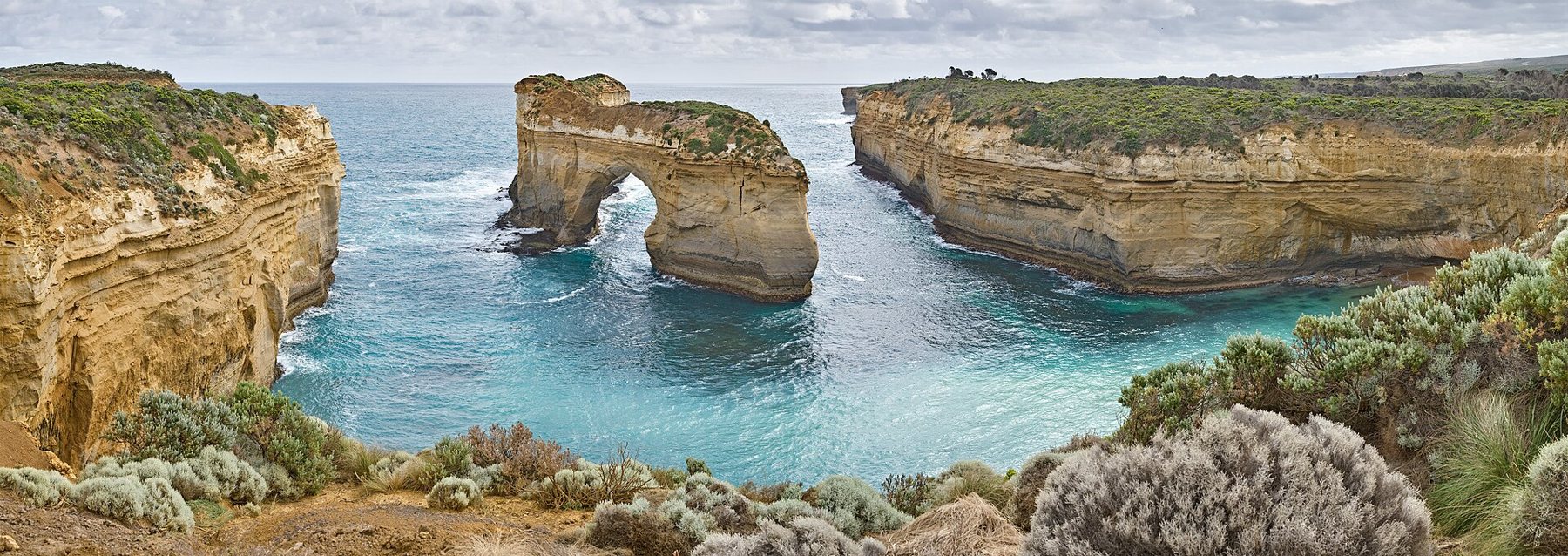
Past Lavers Hill the road comes back to the coast, and the land changes. Instead of hills there is a flat, windswept plain that ends abruptly in sheer limestone cliffs. The sea has cut them into stacks, arches and gorges, and the road runs just inland along the top.
The Twelve Apostles are the best known: limestone stacks standing in the surf off the cliffs in Port Campbell National Park. There are fewer than twelve, and every so often the sea brings another down. The main viewing area is very busy from late morning; go early or near sunset, when the light turns the rock gold. Gibson Steps, just east, take you down to the beach for a view of two stacks from sea level.
Loch Ard Gorge, a few kilometres on, is named for a ship wrecked nearby in 1878; only two people on board survived, washed into the gorge. It is a narrow cove between cliffs, with a small beach you can walk down to. Further west, London Arch and the Bay of Islands are quieter and just as striking. Stay behind the fences at every lookout: the cliff edges are undercut, crumbling and much less solid than they look. The coast here keeps changing: one stack, Island Archway near Loch Ard Gorge, lost its arch in 2009.
Tiredness, wildlife and the road back
The Great Ocean Road is a long, slow, twisting drive, often done as a day trip from Melbourne, and tiredness is a real danger on the way back. Take breaks, swap drivers, and do not plan to drive the whole road and return to the city in one day. Kangaroos and wallabies move at dusk and dawn, and hitting one at speed can wreck a car; slow down when the light goes.
Most drivers return to Melbourne inland along the faster Princes Highway rather than retracing the coast. Fuel is easy in the towns, and stations are spaced closely enough not to worry about. The weather is mild in summer and wild in winter, with fierce wind on the open cliffs at any time of year. October to April brings the warmest days, and December and January the heaviest traffic.
If you enjoy a coast road like this, the Highway 1 through Big Sur in California has the same mix of cliff and ocean on the other side of the Pacific, and South Africa's Garden Route pairs forest and coast at a similar pace.
The photographs on this stop are credited, with their licences, on who took the road photos.